As the quiet of winter settles over Senoia and Peachtree City, the arrival of a Georgia deep freeze shifts the focus from poolside relaxation to winter pool maintenance tips. While our climate rarely requires the “hard winterization” seen in Northern states, the sporadic, intense freezes we experience demand a technical protocol that ensures your investment remains protected.
At J&M Pool Company, we believe that understanding the “why” behind your pool’s behavior during a freeze is the best way to prevent significant equipment damage. Below is the professional standard for what your luxury aquatic environment should – and should not -be doing when the mercury drops.
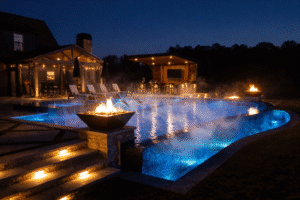
This nighttime retreat, defined by its moody palette and the soft rise of steam, is more than an architectural statement; it is a visual confirmation of a system in motion. By ensuring your automation is correctly configured for rhythmic circulation, your aquatic investment remains a protected, year-round focal point for your estate, even when the mercury drops.
Maintaining the Proper “Active” Water Level
In Georgia, we recommend maintaining your water level at the midpoint of the skimmer throughout the winter. If the water level drops too low due to evaporation, the pump may draw in air. During a freeze, this can cause the pump to lose prime and stop moving water entirely, leading to a “dry freeze” that can crack the pump basket and internal manifold in just hours
Conversely, if heavy winter rains or melting sleet raise the water level above the skimmer opening, the surface debris cannot be cleared, and ice can form more easily across the surface. Regularly checking that your water level is optimal is perhaps the simplest yet most effective maintenance task during the “quiet season.”
What Should Be Happening During Freezing Temperatures?
When ambient air temperatures reach the preset freeze-guard threshold (typically between 35°F and 38°F) your pool’s automation system should take the lead. Homeowners should expect the following technical behaviors from a properly functioning system:
Continuous Circulation: All pumps configured for water circulation must activate automatically. On systems like the Hayward OmniLogic, the pump will maintain a speed equal to or higher than the “Freeze Protect Speed,” and this cannot be manually adjusted downward while the protocol is active.
- Rhythmic Valve Actuation: For pool and spa combination systems, the automation must cycle between modes. You should observe the actuator valves rotating between pool and spa mode approximately every 15 to 30 minutes. This ensures that smaller volumes of stagnant water in the spa plumbing are regularly flushed with moving water to prevent localized ice formation
- Visible Flow and Feature Check: Adequate water flow should be visible from all returns, water features, and spa jets. Note that while circulation is active, the system’s “Spillover” function may be locked out by design to prioritize internal line movement.
- Suspended Functions: To protect the equipment’s long-term integrity, most automation systems will automatically suspend the heater and chemical dispensing (chlorination and pH treatment) while in “Freeze Protect” mode. This prevents condensation damage to the heat exchanger and inaccurate chemical dosing during extreme cold.
- Strategic Bypass: If you wish to use your spa during a freeze, you can temporarily bypass the protection through your app. On OmniLogic systems, tap the snowflake icon in the top-right corner to select a 60, 90, or 120-minute override, which temporarily restores heating functionality while the shared pump is in spa mode.
Diagnostic Red Flags: What Should NOT Happen
Vigilance at the equipment pad is critical when the weather turns extreme. You should contact a professional if you observe any of the following:
- Freeze Guard Failure: If temperatures are below freezing and your pumps have not activated, the system may have a failed air temperature sensor or a programming error that leaves the plumbing stationary and vulnerable to a “dry freeze”.
- Non-Circulation Equipment Activation: Items unrelated to water movement—such as pool lights or air blowers—should not be running during a freeze protection cycle. If these activate, it indicates a programming conflict that can cause unnecessary mechanical wear.
- The “Draining Spa” Phenomenon: If you notice the spa water level dropping while the system is running, it typically points toward an issue with valve positioning or timing. This can often be corrected by ensuring the system is programmed to shut off temporarily during valve transitions, allowing the actuators to align and seal properly before flow resumes.
Winter Pool Maintenance Tips for When the Power Goes Out
The greatest risk to a Georgia pool is a power outage during a hard freeze, as automation can no longer defend the system. In this scenario, you must perform an emergency manual drain to prevent the water in your pipes from expanding and cracking the equipment:
- Turn Off the Breakers: Even though the power is out, turn off the main pool equipment breakers to prevent a surge when the grid comes back online.
- Open the Filter Air Relief: Open the manual air relief valve on top of your filter to break the vacuum and allow water to flow toward the drain points.
- Remove Drain Plugs: Every primary piece of equipment has a winterizing drain plug. You should locate and remove the plugs from the bottom of your pump(s), the bottom of the filter tank, and the side of your heater.
- Drain the Secondary Systems: Do not forget your heater, salt cell, chlorinator, and any booster pumps for cleaners. These smaller volumes of water freeze the fastest.
- Store the Plugs: A professional tip: Place all removed drain plugs in the pump’s hair-and-lint basket and replace the lid. This ensures they are not lost and are ready for the “re-commissioning” once the freeze passes.
- Covering Equipment: If covering pool equipment with a blanket or insulating material, ensure all breakers are turned OFF first. Covering the equipment can help retain heat and keep temperatures under the blanket above freezing, reducing the risk of unnecessary freeze damage.
Professional Stewardship vs. DIY Risk
While many of these winter pool maintenance tips can be handled by a diligent homeowner, the technical complexities of modern pool ecosystems mean that small oversights can lead to five-figure repair bills. A failing temperature sensor or a slightly misaligned actuator valve is often invisible until the first hard freeze reveals the damage.
At J&M Pool Company, our winter maintenance services are designed to identify these vulnerabilities before the temperature drops. Whether it’s verifying the calibration of your air sensors or ensuring your emergency drain plugs are lubricated and accessible, our goal is to provide the peace of mind that comes with professional stewardship. The beauty of a Southern winter is the ability to enjoy the view of a crystal-clear pool year-round. By following these professional protocols, you ensure that your backyard sanctuary is ready to transition seamlessly from the deep freeze of January to the first swim of spring.
Additional Note: In the event of significant freeze damage, manufacturer warranties are void, as they do not cover any damage related to freezing conditions.
The good news is that homeowner’s insurance typically covers repairs required due to freeze damage. J&M Pool Company can assist you throughout the homeowner’s insurance claim process and help guide you every step of the way.